Your toddler brings you a book. You open it. They point, you name, they wait for the page to turn. For a child who is taking their time with words, that little loop is gold.
This guide is for parents of late talkers aged 1 to 3. It covers what makes a book easy to talk about, a short list of well-loved picks, and simple ways to read them. None of it replaces a speech-language pathologist. It is a list of books and play ideas that fit busy family days.
What makes good books for late talkers
Parents of late talkers ask for the same few things, again and again. Here is what to look for on the shelf.
- Few words per page. One or two words, or one short line. Less to listen to means more room to join in.
- A line that repeats. When the same words come back on every page, your child can learn them by heart and fill in the gap.
- Clear pictures. One big thing per page is easier to name than a busy scene. Real photos or realistic art make it easy to link the picture to the real thing.
- Something to do. Flaps to lift, things to point at, animal sounds to copy. Doing comes before saying for many toddlers.
- Words from real life. Ball, cup, dog, more, all done, bye bye. Words your child can use at lunch today.
- Short. A book you can finish in two minutes gets read five times a day.
If a book ticks three or four of these, it is a good one to keep near the couch.
Books for speech delay: well-loved picks
These are popular board books that many families already own. Each one is listed for what it does well. You do not need all of them. One or two, read often, is plenty.
First 100 Words (Roger Priddy). A big board book of everyday things shown as real photos, grouped by topic like food, toys and clothes. Great for pointing and naming. There is no story, so keep it light and follow your child's lead.
Dear Zoo (Rod Campbell). A lift-the-flap book about animals sent from the zoo. The pages follow the same pattern each time, which makes it easy to guess what comes next. Animal sounds give your child an easy first sound to try.
Brown Bear, Brown Bear, What Do You See? (Bill Martin Jr., pictures by Eric Carle). A question and answer pattern that repeats on every page, with one bold animal each time. Many toddlers learn to say the next line before they can say much else.
Where's Spot? (Eric Hill). A puppy hides behind flaps, and you look for him. It has short questions, simple answers, and lots of chances to say "no!" as each flap turns up the wrong animal.
Global Babies (The Global Fund for Children). Real photos of babies' faces from around the world. Babies and toddlers love looking at other little faces. It is a calm book for pointing and naming: eyes, nose, hat, smile.
A book about your own child. The book a toddler asks for most is often the one about them. More on that below.
Your library is a great place to try these first. See which ones your child brings back to you.
A learn to talk book starring your child
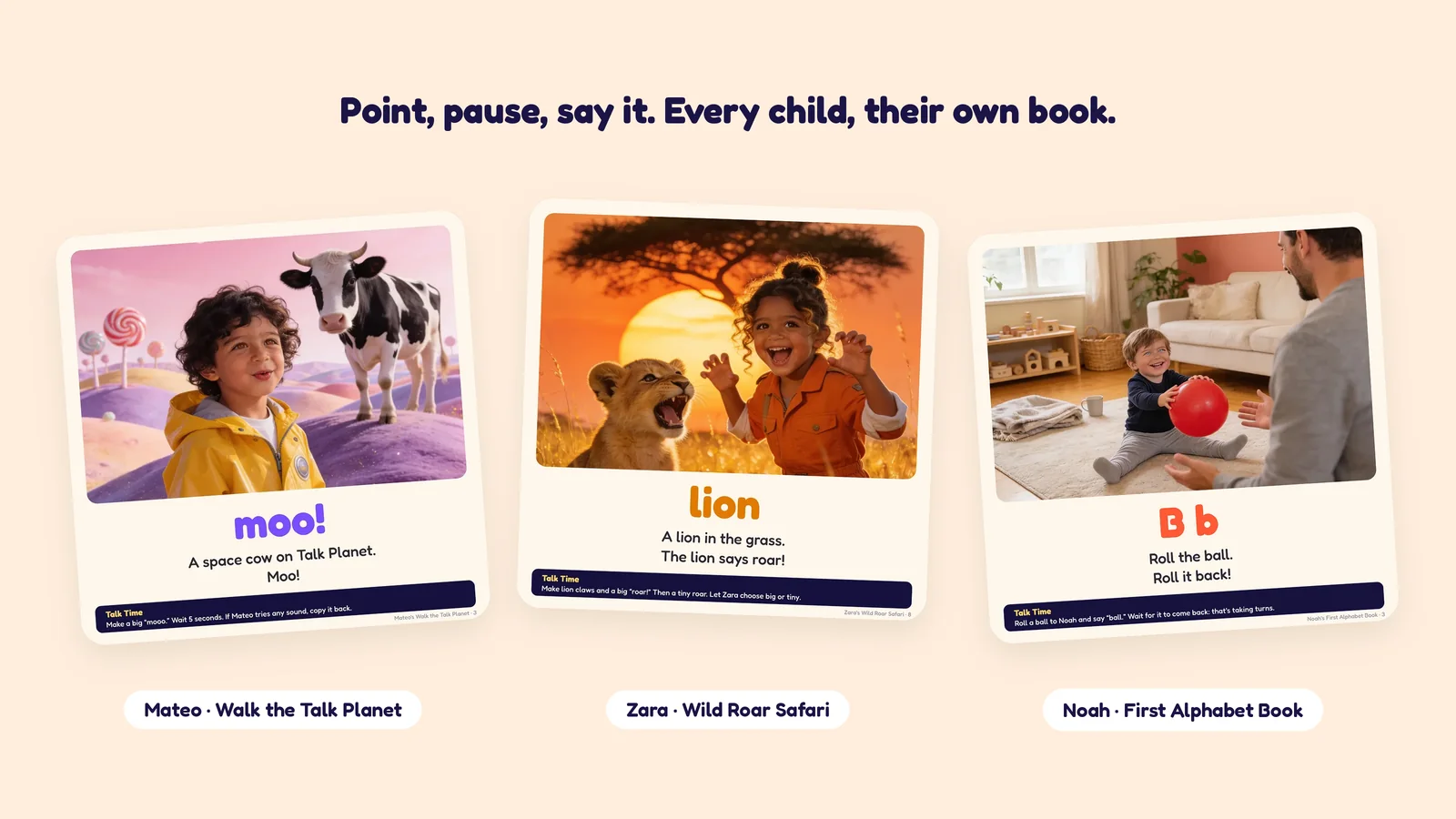
We make My First Words: Walk the Talk Planet, a learn to talk book with your child as the hero. You upload one photo. Your child, and the grown-ups you add, appear on every page in photo-real pictures. Together they fly off to Talk Planet.
Here is how it follows the list above:
- One or two words per page, like "uh-oh!", "moo!" and "vroom!".
- Lines that come back, so your child can join in.
- Words from your child's day. You can add words they already say, words from your home language, and the signs you use.
- A Talk Time tip on every page, a short play idea for you.

Some doctors say "delayed talker" instead of late talker. Either way, every child is different, and no book suits every moment. But when a toddler sees their own face, they often want to point, and pointing is a great place to start.
How to read with a late talker: 7 play ideas
The book matters less than how you share it. Try one or two of these today.
- Pause and wait. Read a line, then stop. Count to five in your head. Give your child a turn: a look, a point, a sound or a word. The quiet feels long to us. It is just right for them.
- Point and name. Point to one thing and say one clear word. "Dog." Not "Look at the big brown dog over there." Short and simple is easy to copy.
- Say it again. Say the same word two or three times across the page. "Ball. Big ball. Ball!" Repeats give your child more chances to try.
- Cheer every try. A sound, a sign, a point or a word all count. Smile, copy it back and keep going. No need to ask them to "say it properly".
- Use baby signs. Show simple signs for more, all done, help and eat as you read and at meals. Signs give your child a way to tell you things while the words are still coming.
- Leave a gap. When a line repeats, stop just before the last word and look at your child. "Brown bear, brown bear, what do you..." Then wait. Caring for Kids, from the Canadian Paediatric Society, suggests this too: pause and let your toddler fill in the words.
- Follow their lead. If they want to stay on one page, stay. If they skip to the end, skip. A short, happy book time beats a long one.
When to talk to a professional
Many late talkers catch up. ASHA, the American Speech-Language-Hearing Association, says about 50 to 70 percent of toddlers with late language emergence catch up with their peers by the late preschool or school years. That also means some do not, and waiting alone will not tell you which group your child is in.
So trust your gut. Talk to your pediatrician or family doctor, or to a speech-language pathologist, if you have concerns. ASHA's public guide for families puts it simply: you don't have to "wait and see" before getting support from a speech-language pathologist.
The CDC milestone checklists are a helpful guide for that talk. By 18 months, most children try to say three or more words besides "mama" or "dada". By 2 years, most say at least two words together, like "more milk". Speak up sooner if your child:
- Does not seem to understand simple words or follow simple directions.
- Uses few gestures, like pointing or waving.
- Does not respond to their name.
- Loses words or skills they used to have.
In the US, you can also contact your state's early intervention program. In Canada, many provinces let parents contact a preschool speech and language service directly, and your family doctor or public health unit can point you there.
Sources:
- ASHA Practice Portal: Late Language Emergence
- Late Talker or Language Problem? (ASHA's public site)
- CDC milestones by 18 months and by 2 years
- Caring for Kids (Canadian Paediatric Society): Your busy toddler
The short version
Pick books with few words, lots of repeats and clear pictures. Read them often, in short bursts. Pause, point, repeat and cheer. And ask for help early if something worries you.
Want a book your late talker will bring back to you? Make My First Words: Walk the Talk Planet with your child as the hero. You see the cover free before you pay. For more ideas, visit our page for all kinds of talkers, or read 2 year old not talking but understands everything? What parents can try at home.
A fun story with play ideas for parents. Not a substitute for speech therapy.