Flashcards have a reputation. Picture a grown-up holding up card after card, a toddler squirming, and a lot of "What's this? What's this?" That is not much fun for anyone.
But flashcards can also be one of the easiest games you play all day. A card is just a picture to talk about. Used the playful way, it gives you and your toddler something to point at, name and laugh about together. This guide covers how to do that, without turning playtime into a test.
First, what flashcards can and can't do
Toddlers learn words from people. They learn when you name the thing they are already looking at, when you wait for their turn, and when you answer the sounds they make. A flashcard doesn't teach a word by itself. It's a prompt that starts that little back-and-forth.
So the goal isn't to get through the deck. The goal is a few warm minutes of looking, naming and taking turns. If your child learns a word along the way, great. If they mostly want to chew the card, that's normal at 12 months too.
How many cards, and for how long?
- Start with three to five cards. Pick things your child sees every day: cup, ball, dog, shoe, banana.
- Keep it short. Two to five minutes is plenty for most toddlers. Stop while it's still fun.
- Repeat the same cards. Toddlers love the familiar. Seeing the same five cards for a week is better than fifty new ones.
- Follow their lead. If they grab the dog card and ignore the rest, talk about the dog.
What to say (and what not to say)
The biggest change you can make is to name, don't quiz. Instead of "What's this?", say the word yourself: "Dog! A big dog." Then pause.
That pause matters. Count to five in your head. Give your child a chance to point, make a sound, sign or try the word. If they do anything at all, answer it: "Woof! Yes, the dog says woof."
A few more tips that keep the pressure off:
- Say one word, clearly. "Ball." Then add a little: "Red ball. Roll the ball."
- Copy their sounds. If they say "ba", say "ba, ball!" back. Every try counts.
- Skip "Say ball. Say ball." Asking a toddler to perform usually makes them go quiet.
- Add a gesture or sign. Many toddlers sign before they talk. A sign is a turn too.
10 flashcard games for toddlers
These games work with any cards, bought or homemade.
- Find the real thing. Show the cup card, then go find a real cup. Hold them side by side. "Cup! Here's your cup."
- Peekaboo cards. Hide a card under a cloth, then pull it away. "Dog! There's the dog!"
- Feed the teddy. Lay out food cards and let teddy "eat" them. "Banana for teddy. Yum!"
- Animal sounds. Hold up an animal and make its sound before you say its name. Let your child join in.
- Two choices. Hold up two cards and ask, "Where's the ball?" Pointing is a great answer.
- Post box. Cut a slot in a shoebox and let your child post each card as you name it.
- Card walk. Lay cards along the hallway floor and name each one as you step past it.
- Match to the room. Tape a card near the real thing: the door card on the door, the cup card by the cups.
- Sort it. For older toddlers, sort cards into piles: animals and food, big and small.
- Story time. String three cards into a tiny story: "The dog. The ball. The dog gets the ball!"
Cards or a flashcard book?
Loose cards are great for games like the post box and the card walk. They are also easy to lose under the sofa. A flashcard book keeps the cards in order, adds a little story and gives you a tip on each page, so you always know what to say next.
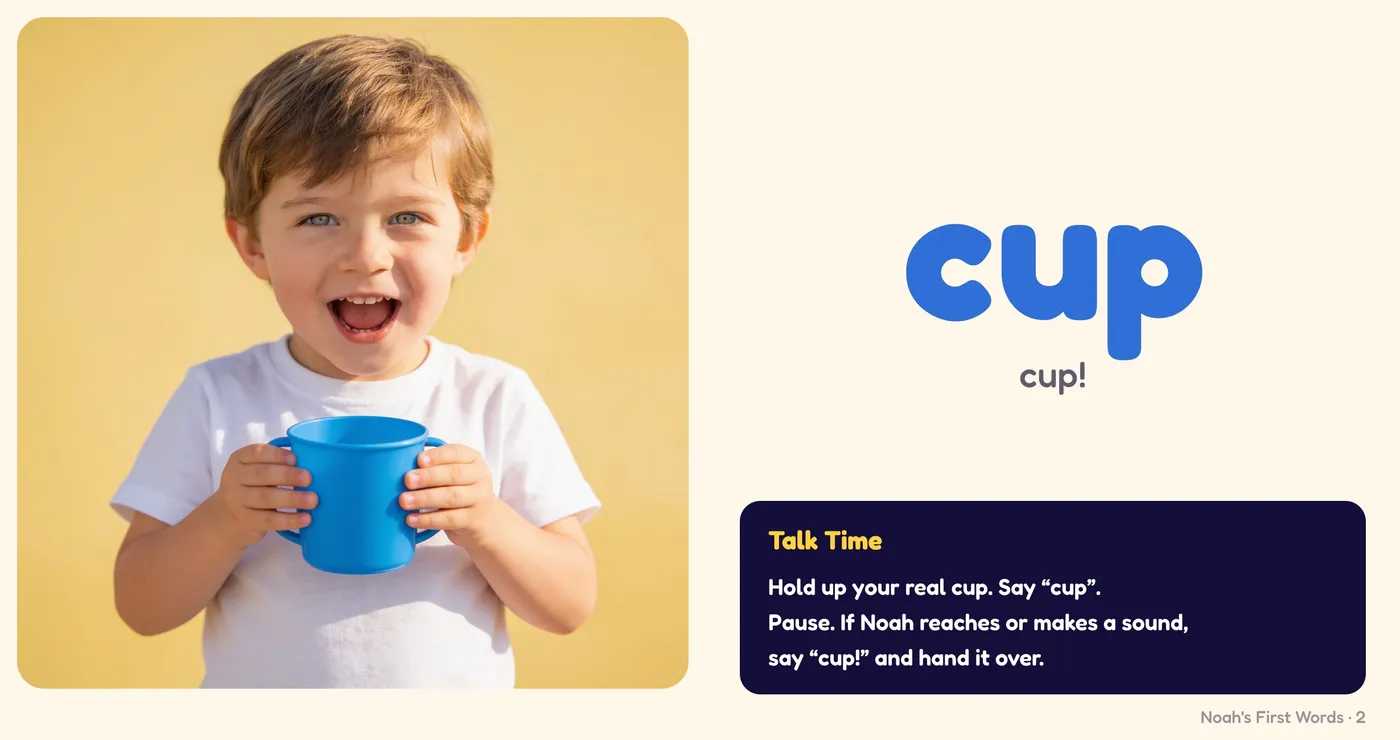
That's the idea behind our personalized flashcard books. Each page works like a big flashcard with one word, letter, animal or number, and your child is in the picture. There's one for alphabet flashcards, one for first words, one for animals and one for numbers. With the Digital Edition you can print extra copies of your favorite pages and use them as loose cards too.
Signs it's time to put the cards away
It's fine to stop. In fact, stopping at the right time is part of keeping it fun. Put the cards away when your toddler:
- turns away, arches their back or starts to fuss,
- throws or chews the cards instead of looking,
- wants to play something else.
Come back tomorrow. Short and often beats long and rare. And remember that the everyday stuff counts even more than cards: talking through bath time, naming food at lunch, singing in the car.
What about babies?
For babies under one, skip the drills entirely. Babies love faces, high-contrast pictures and your voice. Look at a few pictures together, name them in a sing-song voice and follow their gaze. That's plenty.
When to talk to a professional
Every child learns words at their own pace, and flashcards are just one way to play. Still, trust your gut. If you have concerns about how your child understands or uses words, talk to your pediatrician or family doctor, or to a speech-language pathologist.
The CDC milestone checklists are a helpful guide. By 18 months, most children try to say three or more words besides "mama" or "dada". By 2 years, most say two words together, like "more milk", and point to things in a book when you ask. Ask sooner if your child uses few gestures, doesn't respond to their name, or loses words they used to say.
In the US, you can also contact your state's early intervention program. In Canada, your family doctor or public health unit can point you to preschool speech and language services.
A flashcard book starring your child
If your toddler is just starting to talk, My First Words: Walk the Talk Planet is a learn to talk flashcard book made from one photo. It starts with fun sounds, moves on to first words and baby signs, and has a Talk Time tip on every page. For more ideas, visit our page for all kinds of talkers, or read the best first words to teach a 1 to 2 year old.
A fun story with play ideas for parents. Not a substitute for speech therapy.