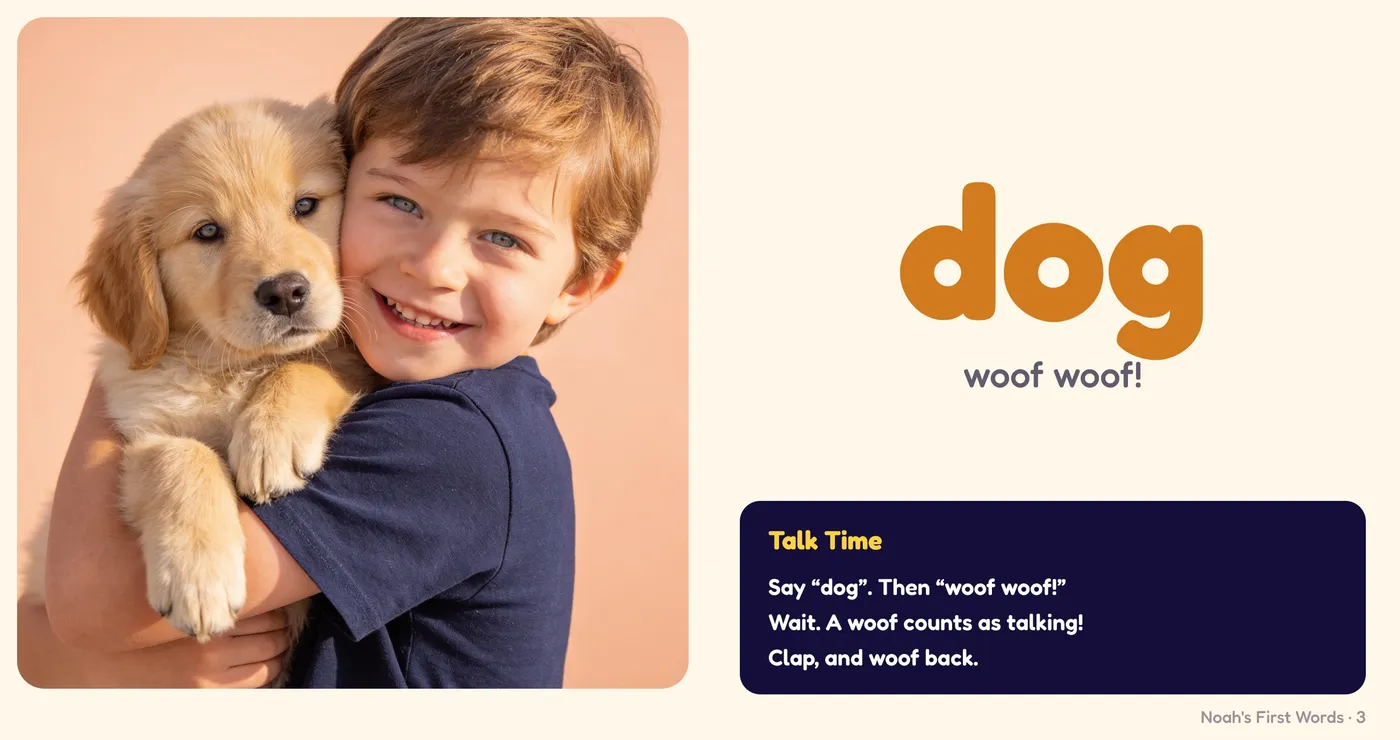
Hold up a flashcard of a dog and your toddler might glance at it. Hold up a card of your toddler hugging a dog and watch what happens. Most parents know the answer before they try it: the second card gets the bigger reaction.
This post looks at why. It compares personalized flashcards, where your child is in the picture, with regular flashcards, and it keeps the claims honest. There's some interesting research here, but it's small, and regular flashcards are still a fine choice.
What's the difference?
Regular flashcards show a word and a picture: a photo or illustration of an apple, a ball, a lion. They're cheap, easy to find, and there are thousands to choose from.
Personalized flashcards show the same kind of word and picture, with one change: your child is in it. They might be holding the apple, rolling the ball or riding past the lion. Some also include family members, a pet, or the child's name in the text.
The word on the card is the same. What changes is who is in the picture.
Why their own face catches their attention
Young children pay special attention to things that are about them. A few findings point that way.
- Their own name. In a well-known study, Mandel, Jusczyk and Pisoni found that babies as young as four and a half months listened longer to their own name than to other names. Long before they talk, babies tune in to the sound that means "you".
- Their own face. Most children start to recognize themselves in a mirror somewhere between 18 and 24 months. Around then, many toddlers become fascinated by photos of themselves and love to point and say their name or "me!"
- Familiar people. Toddlers are drawn to faces they know. A picture with Mom, Dad or Grandma in it gives them something extra to point at and name.
None of this means a personalized card teaches a word faster. It means it's more likely to catch and hold your child's attention, and attention is where shared reading starts.
What research says about personalized books
There's a small body of research on personalized books, much of it led by Natalia Kucirkova and colleagues. In one study, published in the journal First Language in 2014, three-year-olds learned more new words from a book personalized with their own name than from a similar book without it.
That's encouraging, but it's one small study with a small group of children, and it tested names in the text rather than photos. Researchers in this area also point out that what matters most is the conversation around the book: whether the adult and child talk, point and take turns. A personalized book is a good reason to have that conversation. It isn't a shortcut around it.
There's also related research on real pictures. Studies led by Patricia Ganea found that toddlers were more likely to link a word from a picture book to the real object when the book used photographs or realistic pictures rather than cartoons. We cover that in more detail in why real photo books work for toddlers.
Personalized vs regular flashcards, side by side
Here's a fair comparison.
Where personalized flashcards shine:
- Attention. A child who sees themselves on the card usually wants to look longer.
- Talking. "That's you! What are you holding?" Personalized cards start conversations on their own.
- Real life links. When the child is holding a cup in the picture, it's an easy jump to the real cup on the table.
- Keepsake. A book of your child at this age becomes a family memory.
Where regular flashcards shine:
- Price and variety. A regular deck costs a few dollars and comes in every topic you can think of.
- Quantity. You can have hundreds of words on hand.
- Speed. No photo to upload, no wait.
Many families use both: a regular deck for variety, and a personalized book for the words and moments that matter most.
How to get the most from either kind
Whichever cards you use, the way you play matters more than the card itself.
- Name, don't quiz. Say the word, then wait for your child's turn.
- Keep it short. A few minutes, a few cards, and stop while it's fun.
- Link to real life. Find the real ball after the ball card.
- Cheer every try. A point, a sign or a sound all count.
We share ten simple games in how to use flashcards with a toddler.
What to look for in personalized flashcards
If you decide to try personalized flashcards, a few things are worth checking.
- Does it really look like your child? Ask for a preview before you pay.
- One thing per card. Busy scenes are harder to name than one clear thing.
- Everyday words. The words your child hears every day are the easiest to learn.
- A tip for you. Short prompts on each page help you know what to say and when to wait.
- Your photos are safe. Check how long the company keeps them and how to delete them.
When to talk to a professional
Personalized or not, flashcards are a playful extra, not a way to diagnose or change how a child develops. Every child learns words at their own pace. If you have concerns about how your child understands or uses words, talk to your pediatrician or family doctor, or to a speech-language pathologist.
As a rough guide from the CDC milestone checklists, by 18 months most children try to say three or more words besides "mama" or "dada", and by 2 years most say two words together. Ask sooner if your child uses few gestures, doesn't respond to their name, or loses words they used to say. In the US you can contact your state's early intervention program, and in Canada your family doctor or public health unit can point you to preschool speech and language services.
Sources:
- Mandel, Jusczyk and Pisoni (1995), Infants' recognition of the sound patterns of their own names, Psychological Science
- Kucirkova, Messer and Sheehy (2014), Reading personalized books with preschool children enhances their word acquisition, First Language
- Ganea, Pickard and DeLoache (2008), Transfer between picture books and the real world by very young children, Journal of Cognition and Development
- CDC, Learn the Signs. Act Early. milestone checklists
Try a personalized flashcard book
Our personalized flashcard books put your child on every page: alphabet flashcards, animal flashcards, number flashcards and a learn to talk book, My First Words: Walk the Talk Planet. You see the cover free before you pay. For families of late talkers, bilingual families and children who use signs or AAC, see our page for all kinds of talkers.
A fun story with play ideas for parents. Not a substitute for speech therapy.